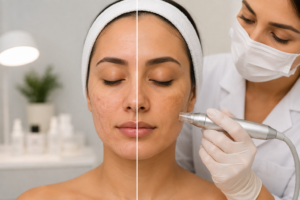
Acne scars can stay long after breakouts clear, and the right acne scar treatment depends on the kind of scar you have. Boxcar, rolling, ice pick, and raised scars each respond differently to treatment. This guide shows you how to tell your scar types apart and match each one to the treatments that work best, so you can plan your next step with confidence.
Key Takeaways
- Match the treatment to the scar. Boxcar, rolling, ice pick, and hypertrophic scars each need a different approach for real acne scar reduction.
- Know your two main groups. Atrophic scars sit below the skin, while hypertrophic scars rise above it.
- Deep scars need stronger tools. Ice pick and deep boxcar scars often respond best to ablative laser or minor surgical methods.
- Mild scars have gentler options. Microneedling and chemical peels improve mild acne scars with less downtime.
- Plan for multiple sessions. Microneedling usually requires 3 to 6 sessions, while some lasers show results in 3 sessions.
- See a dermatologist first. A professional exam gives you the safest, fastest path to clearer skin.
What Causes Acne Scars in the First Place?
Acne scars form when a breakout damages the skin deep below the surface. Inflammation breaks down collagen, and your skin repairs the area unevenly. Too little collagen leaves a dent. Too much collagen leaves a raised bump.
Picking or squeezing pimples increases your risk of scarring, since it pushes bacteria deeper and worsens inflammation. Cystic and nodular acne carry the highest risk because they reach deep into the skin. The American Academy of Dermatology notes that early acne treatment is the best way to prevent scars from forming.
Types of Acne Scars
You need to know your scar type before you choose a treatment. Acne scars fall into two main groups: atrophic and hypertrophic. Here are the types of acne scars you are most likely to see.
Boxcar Scars
Boxcar scars are broad depressions with sharp, defined edges. They look like small craters and often appear on the lower cheeks and jaw, where skin is thicker. Widespread acne or chickenpox usually causes them.
Rolling Acne Scars
Rolling acne scars have sloping edges that give the skin a wavy, uneven look. They vary in depth and blend into the surrounding skin without sharp borders. Bands of tissue under the skin pull the surface down, which creates the rolling shape.
Ice Pick Scars
Ice pick scars are narrow, deep holes that point down into the skin. They look like small punctures and often show up on the cheeks. These scars reach deep, so they are the hardest type to treat and usually need focused methods.
Hypertrophic Scars
Hypertrophic scars rise above the skin as firm, raised bumps. They form when your skin makes too much collagen during healing. These scars appear most on the jawline, chest, back, and shoulders, and they are more common in darker skin tones.
This table gives you a quick way to tell the types of acne scars apart.
| Scar Type | How It Looks | Common Areas |
|---|---|---|
| Boxcar | Broad dents, sharp edges | Lower cheeks, jaw |
| Rolling | Wavy, sloping dents | Cheeks, wider areas |
| Ice pick | Narrow, deep holes | Cheeks |
| Hypertrophic | Raised, firm bumps | Jaw, chest, back, shoulders |
Best Acne Scar Treatment Types by Scar
The best acne scar treatment types depend on your scar shape and depth. Here is how each scar responds to the main options.
Boxcar Scars Treatment
Boxcar scars treatment works well with fractional laser resurfacing, which smooths sharp edges and builds collagen. Microneedling helps shallower boxcar scars, often across several sessions. For deeper single scars, a dermatologist may use punch excision to remove and close the scar.
Rolling Acne Scars Treatment
Rolling acne scars respond well to subcision, a method that releases the tissue bands pulling the skin down. Microneedling and radiofrequency microneedling then boost collagen to lift the surface. Many people combine these two methods for the best acne scar reduction.
Ice Pick Scars Treatment
Ice pick scars need methods that reach deep into the skin. The TCA CROSS technique places a small amount of trichloroacetic acid into each scar to rebuild collagen. Punch excision also works well for removing narrow, deep scars one at a time.
Hypertrophic Scars Treatment
Hypertrophic scars need methods that flatten raised tissue. Steroid injections soften the scar over several sessions spaced weeks apart. Laser therapy and silicone sheeting also help reduce height and smooth the surface.
How to Get Rid of Acne Scars: Treatments Compared
If you want to know how to get rid of acne scars, it helps to compare the three most common in-office treatments. Each one suits different scars, skin tones, and downtime limits.
Microneedling
Microneedling uses fine needles to create tiny channels that trigger collagen. It works well for mild acne scars, rolling scars, and shallow boxcar scars. You need 3 to 6 sessions spaced 4 to 6 weeks apart, with only 1 to 3 days of redness. It is safe across all skin tones because it does not rely on light.
Laser Resurfacing
Laser resurfacing uses focused light to remove damaged skin and build collagen. Ablative fractional lasers give the strongest results for deep boxcar and ice pick scars, often in 1 to 2 sessions. Downtime runs longer, from 2 days to 2 weeks. People with darker skin need a careful plan, since aggressive lasers raise the risk of post-inflammatory hyperpigmentation.
Chemical Peels
Chemical peels use acids like glycolic or TCA to remove the top layers of skin. They work best for mild acne scars, surface texture, and dark marks left after acne. Downtime ranges from 1 to 7 days based on the peel strength. Deep scars usually need a stronger method alongside peels.
This table compares the three main treatments so you can weigh your options.
| Treatment | Best For | Sessions | Downtime |
|---|---|---|---|
| Microneedling | Mild, rolling, shallow boxcar | 3 to 6 | 1 to 3 days |
| Laser resurfacing | Deep boxcar, ice pick | 1 to 3 | 2 days to 2 weeks |
| Chemical peels | Mild scars, dark marks | 3 to 6 | 1 to 7 days |
Acne Scar Removal at Home for Mild Scars
You can improve mild acne scars at home while you plan professional care. These steps support acne scar removal and protect your results.
- Use a retinoid. Over-the-counter retinoids like adapalene boost collagen and even out skin tone over time.
- Apply sunscreen daily. Broad-spectrum SPF 30 or higher prevents dark marks from deepening and protects healing skin.
- Try silicone sheets. Silicone sheeting can soften and flatten raised hypertrophic scars.
- Skip at-home peels. Strong DIY acids can damage skin, so leave deeper peels to a professional.
Home care helps with surface marks and mild texture. Deeper scars need in-office treatment for real change.
Summary
The best acne scar treatment starts with knowing your scar type. Boxcar and ice pick scars often need laser or surgical methods, while rolling and mild scars respond to microneedling and subcision. Raised hypertrophic scars need steroid injections or laser therapy to flatten them.
Most people get the best acne scar reduction from a plan that combines two or more methods. Ready to treat your acne scars with a plan built for your skin? Book a consultation at Ayana Dermatology & Aesthetics in Fort Lauderdale to explore microneedling, laser resurfacing, chemical peels, and more.
Frequently Asked Questions
What is the best acne scar treatment for deep scars?
Deep scars like ice pick and deep boxcar scars respond best to ablative fractional laser resurfacing, TCA CROSS, or punch excision. A dermatologist can match the right method to your scar depth and skin tone.
Can acne scars go away on their own?
True acne scars are permanent changes in the skin, so they do not fully fade on their own. Dark marks left after acne, called post-inflammatory hyperpigmentation, do fade over time with sun protection.
How many sessions does acne scar removal take?
It depends on the method. Microneedling usually needs 3 to 6 sessions, laser resurfacing often needs 1 to 3, and chemical peels work as a series of 3 to 6. Your provider gives you a plan at your consultation.
Which treatment is best for rolling acne scars?
Rolling acne scars respond best to subcision, which releases the tissue bands under the skin, often paired with microneedling to build collagen. Many people see the best results when they combine both.
Is microneedling or laser better for acne scars?
Microneedling suits mild to moderate scars and all skin tones with little downtime. Laser resurfacing treats deeper scars more powerfully but needs more recovery. Your scar depth and skin tone guide the choice.
How can I treat mild acne scars at home?
You can use an over-the-counter retinoid, apply daily broad-spectrum sunscreen, and try silicone sheets for raised scars. Home care helps mild scars, though deeper scars need in-office treatment.
Does acne scar treatment work on all skin tones?
Yes, but the right method matters. Microneedling is safe across all skin tones, while aggressive lasers and deep peels carry a higher risk of dark marks on deeper skin tones. A dermatologist tailors the plan to your skin.
How much does acne scar treatment cost?
Acne scar treatment cost varies by method, scar severity, and the number of sessions you need. Microneedling often runs a few hundred dollars per session, while laser packages can cost more. Your provider gives you an exact quote at your visit.