Microneedling vs. laser comes down to one question: how much downtime can you accept for how much change? Both treatments build collagen. Lasers work faster and reach deeper. Microneedling stays gentler and safer across every skin tone. Here is how the two compare on results, recovery time, cost, and your specific skin concern.
Key Takeaways
- Lasers deliver more correction; microneedling delivers more safety. In a split-face trial of 30 patients, fractional CO2 laser improved acne scar grades by 32.9% against 9.3% for microneedling.
- Pigmentation risk decides it for many patients. That same study reported post-inflammatory hyperpigmentation in 30% of laser-treated sides against 6.67% of microneedled sides, concentrated in higher Fitzpatrick skin types.
- Plan your calendar around downtime. Microneedling costs you 1 to 3 days. Non-ablative laser requires 1 to 7 days of downtime. Ablative CO2 laser costs 7 to 14 days with redness that can linger for weeks.
- Budget by the series, not the session. Microneedling averages about $950 per treatment and needs 3 to 6 sessions. Laser resurfacing averages $2,872 and can reach $8,500.
- Treat scar type as the deciding factor. Rolling and boxcar scars respond well to both. Ice-pick scars respond poorly to either, so ask about punch excision or TCA CROSS instead.
- Book a consultation before you book a treatment. A board-certified dermatologist matches the device to your Fitzpatrick type, your scar depth, and your schedule.
What Is Better, Microneedling or Laser?
Neither wins outright. The right answer depends on your skin tone, your concern, and how many recovery days you can give up.
The clearest head-to-head data comes from a split-face study of 30 patients published in the Indian Dermatology Online Journal. Each patient received fractional CO2 laser on one side of the face and microneedling on the other, four monthly sessions each.
The laser side improved acne scar grades by 32.9%. The microneedling side improved acne scar grades by 9.3%. Patient satisfaction followed the same pattern: 49.4% vs 19.7%.
The laser side also developed post-inflammatory hyperpigmentation in 30% of cases, compared with 6.67% on the microneedling side, and took longer to heal. Stronger results carry a higher risk.
How Each Treatment Works
Collagen induction therapy
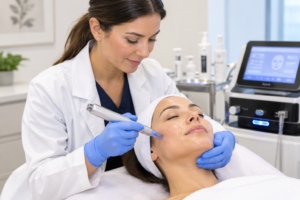
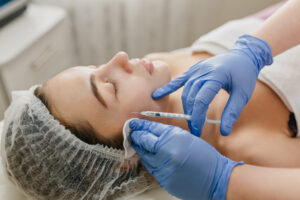
Microneedling uses fine needles to create thousands of controlled micro-injuries. Your body repairs them with fresh collagen and elastin, which is why dermatologists call it collagen induction therapy.
The process adds no heat and no light, so it carries no pigment risk. The American Academy of Dermatology confirms microneedling is safe for all skin tones.
Laser resurfacing
Lasers deliver focused light energy that heats or removes tissue. The category splits into two.
- Non-ablative lasers heat the dermis without removing the surface. Expect 1 to 3 days of redness and multiple treatments.
- Ablative lasers such as CO2 and erbium remove layers of skin. Expect 7 to 14 days of healing and the strongest single-session results.
Radiofrequency microneedling sits between the two. It adds heat through the needles for deeper remodeling and stays safe across all skin types, with 2 to 5 days of downtime.
Microneedling vs. Laser Treatment: The Comparison
| Factor | Microneedling | Laser Resurfacing |
|---|---|---|
| How it works | Needle micro-injuries trigger collagen | Light energy heats or removes tissue |
| Downtime | 1 to 3 days | 1 to 7 days non-ablative, 7 to 14 days ablative |
| Sessions needed | 3 to 6, spaced 4 weeks apart | 1 ablative, or 3 to 6 non-ablative |
| Safe for darker skin | Yes, all Fitzpatrick types | Higher pigmentation risk in types IV to VI |
| Acne scar improvement | 9.3% scar grade in split-face data | 32.9% scar grade in split-face data |
| Pigmentation side effect | 6.67% in split-face data | 30% in split-face data |
| Typical cost | About $950 per treatment | About $2,872 average, up to $8,500 |
| Best for | Texture, pores, mild scars, all skin tones | Sun damage, deep wrinkles, severe scarring |
Microneedling vs. Laser for Acne Scars
Your scar type matters more than the device. The split-face data breaks down clearly by shape.
- Rolling scars: 42.9% improvement with laser, 16.18% with microneedling
- Boxcar scars: 36.18% with laser, 3.74% with microneedling
- Ice-pick scars: poor response to both treatments
Scars younger than 10 years responded better to both approaches. If your scars are deep and narrow, ask your dermatologist about punch excision or TCA CROSS, which target ice-pick scars directly.
Adding platelet-rich plasma to microneedling can help close some of the gap. The AAD reports that 3 to 5 microneedling sessions with PRP fade acne scars by 50% to 70%.
Microneedling vs. Laser for Wrinkles
Fine lines respond to both. Microneedling softens them gradually over a series, and results peak 3 to 6 months after your final session.
Deep wrinkles need more energy. Ablative laser resurfacing remains the stronger option, and results can hold for 3 to 5 years.
Static lines etched into the skin respond to resurfacing. Lines that appear only when you move your face come from muscle activity, which is a different problem with a different solution.
Which Is Best for Large Pores?
Microneedling handles enlarged pores well and costs you very little recovery time. Collagen built around the pore opening tightens its appearance.
Pore size has a genetic component, so expect improvement, not elimination. Plan a series of 3 to 6 sessions, then maintenance every 6 to 12 months.
Microneedling vs. Laser Cost
Patient-reported data on RealSelf puts microneedling at about $950 per treatment, with single sessions from $200 to $800. A full course of 3 to 6 sessions lands between $600 and $4,200.
Laser resurfacing averages $2,872 and can reach $8,500. Ablative treatments cost more per session and often need only one. Non-ablative treatments cost less per session and require a series.
Ask for a quote covering the entire plan. A per-session price tells you very little when session counts differ this much.
Microneedling Downtime: What to Expect
Your first 7 days
- Day 1: redness and warmth similar to a mild sunburn
- Day 2: redness fades toward pink, most people return to work
- Days 3 to 4: light flaking and dryness
- Days 5 to 7: skin looks normal, and makeup goes on cleanly
Wait a full 24 hours before applying makeup. Use SPF 30 or higher every morning, and pause retinoids and acids for 5 to 7 days.
What Should You Do First, Microneedling or Laser?
Start with the gentler option when your concern is mild, or your skin tone is Fitzpatrick IV or above. Microneedling gives you a baseline with almost no risk.
Start with laser when you have significant sun damage, deep wrinkles, or severe scarring and your skin tone tolerates it well.
Many dermatologists alternate the two across a treatment year. Laser corrects pigment and depth; microneedling maintains texture between sessions. Space the treatments at least 4 weeks apart and let your skin fully heal before the next one.
Safety and Who Should Wait
Both treatments belong in medical hands. The AAD warns that lasers used by untrained people can be dangerous, with risks including burns, discoloration, and new scarring.
Postpone either treatment if you have a fresh tan, an active skin infection, or inflamed cystic acne. People prone to keloids, those on immunosuppressants, and anyone who took isotretinoin within the past month need a different plan.
Summary
Microneedling vs. laser is a trade-off between correction and risk. Lasers produce larger gains on acne scars and deep wrinkles, with more downtime and a real pigmentation risk in darker skin. Microneedling works gradually, suits every skin tone, and costs you a few days at most. Your Fitzpatrick type, your scar type, and your recovery window point to the answer, and a board-certified dermatologist confirms it.
Microneedling and Laser in Fort Lauderdale
At Ayana Dermatology & Aesthetics, Dr. Cherise M. Levi, a board-certified dermatologist in Fort Lauderdale, FL, examines your skin and matches either the laser or microneedling treatment to your Fitzpatrick type, concerns, and schedule. Your consultation covers which device fits, how many sessions you need, and what recovery looks like.
Call 954.727.5700 or book an appointment online to get started.