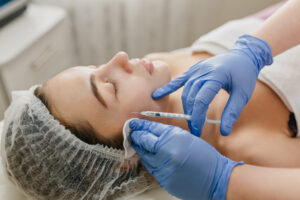
Microneedling with exosomes and microneedling with PRP both promise smoother skin, fewer scars, and a stronger glow. Both treatments start the same way but finish very differently. One uses lab-purified signals from stem cells. The other uses a vial of your own blood. Here is how they compare on results, comfort, cost, and recovery.
Key Takeaways
- Same procedure, different boost. Both use a microneedling pen to open micro-channels. Exosomes add lab-purified stem cell signals. PRP adds growth factors spun from your own blood.
- Results land close together. In the first head-to-head split-face trial, both sides improved photoaging scores by 37% at three months, with exosomes slightly ahead on wrinkles, redness, and texture.
- Acne scars respond well. The American Academy of Dermatology reports that 3 to 5 microneedling sessions with PRP fade acne scars by 50% to 70%.
- Exosomes save time and needles. Preparation takes under 5 minutes with no blood draw, compared with 15 to 20 minutes for PRP.
- Budget for a series. Plan on 3 to 6 sessions. Microneedling averages roughly $950 per treatment nationally, and add-ons raise the per-session price.
- Ask about the product. The FDA has approved no exosome product. Topical application after microneedling is the only route a board-certified dermatologist should offer you.
Is It Worth Adding Exosomes to Microneedling?
For most people treating texture, tone, and scar depth, yes. Microneedling alone triggers collagen. Adding a regenerative serum gives those open channels something useful to absorb.
A 12-week randomized split-face study in the Journal of Cosmetic Dermatology tested exosome solution plus microneedling against saline plus microneedling in 28 patients. The exosome side cut wrinkle roughness by 12.4% to 14.4%, compared with 6.6% to 7.1% on the control side. Skin elasticity rose 11.3% on the exosome side and fell 3.3% on the control side.
What Microneedling Does on Its Own
A microneedling pen creates thousands of controlled micro-injuries in your skin. Your body answers with fresh collagen and elastin. Dermatologists call this collagen induction therapy.
Microneedling benefits
- Softer fine lines and wrinkles
- Smaller-looking pores
- More even skin tone and texture
- Fading of brown spots and melasma
- Improvement in surgical scars and stretch marks
- Safe use across every skin tone, since the treatment adds no heat
The American Academy of Dermatology lists all of these as standard targets for in-office microneedling.
Microneedling for acne scars
Acne scars are where microneedling earns its reputation. The AAD reports that 3 to 5 sessions, spaced 2 to 4 weeks apart, fade acne scars by 50% to 70%.
Adding PRP pushes the number higher. In a split-face study of 50 patients, the PRP side improved 62.2% while the side treated with microneedling alone improved 45.84%.
Microneedling with Exosomes vs. PRP: Four Differences That Matter
Source Material
PRP comes from you. A technician draws your blood and spins it to concentrate platelets. That sample reflects your age, your medications, and your health on the day.
Exosomes come from a laboratory. Most products use vesicles from cultured mesenchymal stem cells, often donors aged 18 to 25. Every vial carries the same standardized dose.
Mechanism & Delivery
Both products use the same delivery route. Microneedling opens temporary channels, and the serum travels through them into the dermis. Exosomes are too large to cross intact skin alone, so those channels do the work.
PRP floods the tissue with growth factors such as PDGF, VEGF, and TGF-beta. Exosomes deliver RNA and protein cargo that instructs your fibroblasts to build collagen and calm inflammation.
Onset & Duration of Results
Collagen remodeling runs on its own clock with either add-on:
- Weeks 1 to 2: redness settles, and skin looks brighter
- Weeks 4 to 6: texture and tone start to shift
- Months 2 to 3: scar depth and wrinkle depth improve
- Month 6: collagen peaks, then declines slowly
In the head-to-head trial, photoaging scores improved 37% at three months and held a 22% gain at six months on both sides of the face. Plan a maintenance session about once a year.
Convenience & Comfort
Here, the two separate cleanly. Exosome solution needs under 5 minutes of preparation. PRP needs 15 to 20 minutes plus a blood draw.
Trial investigators rated preparation discomfort as mild to moderate for PRP and none for exosomes. If needles make you lightheaded, that difference decides it.
| Factor | Microneedling with Exosomes | Microneedling with PRP |
|---|---|---|
| Source material | Lab-cultured stem cells, young donors | Your own blood |
| Preparation time | Under 5 minutes | 15 to 20 minutes |
| Blood draw | None | Required |
| Dose consistency | Standardized in every vial | Varies with your age and health |
| Discomfort from prep | None | Mild to moderate |
| Typical downtime | 2 to 5 days of redness | 2 to 5 days of redness |
| Best fit | Mature skin, pigmentation, needle-averse patients | Patients who want a treatment from their own body |
| Regulatory status | No FDA-approved product, topical use only | Autologous blood product in wide clinical use |
Microneedling with Exosomes vs. PRF: Where PRF Fits
PRF, or platelet-rich fibrin, is the slower relative of PRP. You spin your blood at a lower speed without an anticoagulant, leaving a natural fibrin scaffold behind. That scaffold releases growth factors gradually over 7 to 14 days.
Patients often ask what is better, PRF or microneedling. The question compares two different things. Microneedling is the procedure. PRF is the add-on that goes with it, and the pair beats either one alone.
Choose PRF when you want a fully autologous treatment, and you are under 45 with healthy platelet counts. Choose exosomes when you want consistent potency at any age.
Which Type of Microneedling Is Most Effective?
The best answer depends on the concern in front of you:
- Deep atrophic acne scars: radiofrequency microneedling, which adds heat for deeper dermal remodeling
- Fine lines and dull tone: standard microneedling with exosomes
- Early laxity in mature skin: radiofrequency microneedling with exosomes
- Needle-averse patients: standard microneedling with exosomes
- Patients who prefer their own biology: microneedling with PRP or PRF
Radiofrequency microneedling is safe for all skin tones, and the AAD notes that some studies show results comparable to a laser with less downtime.
Microneedling with Exosomes Cost
Price depends on your city, provider, and treatment depth. Patient-reported data on RealSelf puts the average microneedling treatment at about $950, with single sessions running from $200 to $800.
Regenerative add-ons raise that figure. Microneedling with PRP averages around $830 per session in the same data set, and exosome serums sit in a similar range.
Budget for the series rather than one visit. Three to six sessions is standard, and most practices discount a package.
Microneedling Aftercare: Your First Week
Your skin barrier stays open for roughly 24 hours after treatment. Treat that window seriously.
- Skip makeup for a full 24 hours
- Wash with lukewarm water and a plain cleanser for 3 days
- Apply broad-spectrum SPF 30 or higher every morning
- Avoid direct sun, saunas, steam rooms, and hard workouts for 48 hours
- Pause retinoids, exfoliating acids, and vitamin C for 5 to 7 days
- Leave any flaking alone and let it shed
Expect redness that feels like a mild sunburn. The AAD notes it usually clears within a few days to a week.
Safety, Screening, and the FDA Position on Exosomes
Microneedling suits most people and every skin tone. Your dermatologist will postpone it if you have inflamed acne, a skin infection, a fresh tan, or recent isotretinoin use. Keloid formers and patients on immunosuppressants need a different plan.
Exosomes carry one extra consideration. The FDA has approved no exosome product for any therapeutic use, and it issued a public safety notification after patients in Nebraska developed serious infections from unapproved products.
Case reports have linked injected exosomes to granulomas, skin necrosis, and anaphylaxis. Topical application after microneedling is the route with published safety data behind it. Ask your provider which product they use.
Summary
Microneedling with exosomes and microneedling with PRP both work. The head-to-head evidence shows comparable improvement in wrinkles, pigment, redness, and texture, with exosomes slightly ahead on several measures and clearly ahead on convenience. PRP gives you an option drawn entirely from your own body. Your age, skin type, and comfort with needles should drive the decision, and a board-certified dermatologist can make that call with you.
Microneedling in Fort Lauderdale
At Ayana Dermatology & Aesthetics, Dr. Cherise M. Levi, a board-certified dermatologist in Fort Lauderdale, FL, builds each plan around your skin type, your history, and your goals. Your consultation covers which add-on fits, how many sessions you need, and what recovery looks like.
Call 954.727.5700 or book an appointment online to get started.